
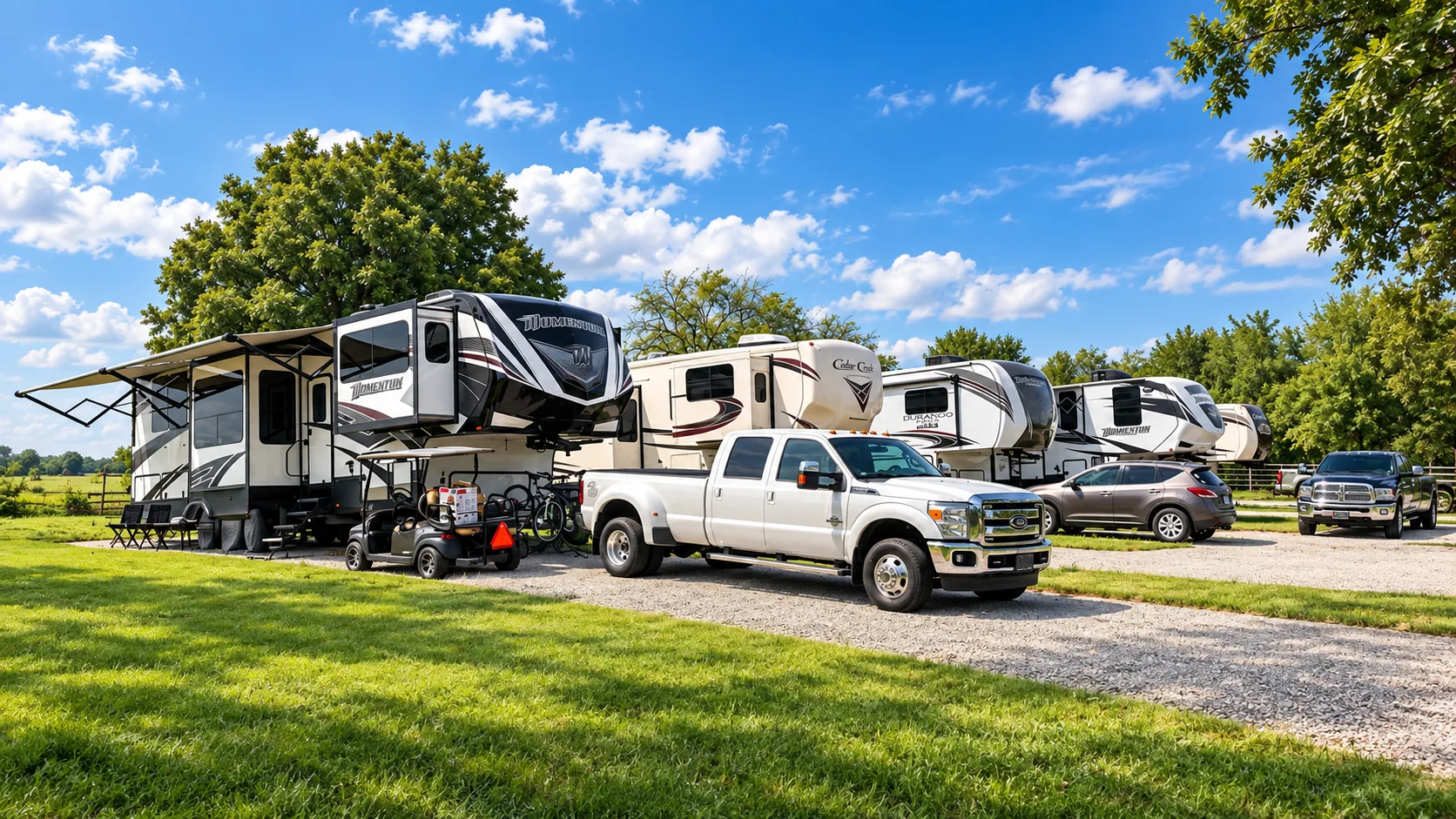
A first RV trip checklist comes down to arriving in daylight, backing in with one person spotting, then hook up in this order: power off at the pedestal, plug in, power on; water through a pressure regulator; sewer last, with the black tank valve closed until the tank is two-thirds full. Never put flushable wipes down an RV toilet – they do not break down, and they are the single most common cause of a blocked tank. Level the rig before you put the slides out. Pack a water pressure regulator, a drinking-safe hose, a sewer hose with a clear elbow, wheel chocks, leveling blocks, a surge protector and both power adapters. Book a pull-thru site for your first stay if one is available – it removes the only genuinely stressful part of the day.
Before you leave the driveway
Almost everything that goes wrong on a first trip was decided at home. Three things matter more than the rest.
Know your numbers
Write them on a card and keep it on the dash: total length, total height, and weight. Height is the one that ruins days – a lot of drivers discover their air conditioner shroud at a canopy. Length decides which sites you can book. Our Standard sites take rigs to about thirty-five feet, and Premium Gold and Premium Platinum take up to fifty.
Check the tires, properly
Cold pressure to the sticker, and look at the date codes. RV tires age out long before they wear out, and a trailer that sat for two years is on old rubber regardless of tread.
Do a dry run in the driveway
Put the slides out, run the fridge on propane for a few hours, run a tap, flush the toilet. Find the broken thing at home where it is an errand, not two hundred miles away where it is the weekend.
What goes on a first RV trip checklist?
Ignore the eighty-item lists. This is the short first RV trip checklist that covers a first weekend.
- Water pressure regulator. Non-negotiable. City water pressure can be far above what RV plumbing is rated for, and this is a common way to flood a rig.
- Drinking-water-safe hose, white or blue, plus a spare washer or two.
- Sewer hose with a clear elbow. The clear section is how you know the black tank has finished.
- Disposable gloves. Obvious in hindsight.
- Wheel chocks and leveling blocks.
- Surge protector or EMS, and both dogbone adapters.
- RV-safe toilet paper and a black tank treatment.
- A flashlight, a basic tool kit, duct tape and a headlamp.
- An outdoor mat and folding chairs, because most of the point is sitting outside.
Bedding, towels and kitchen kit if you are in a rig. If you are in one of our cabins, all of that is already there.
How do you arrive without the stressful part?
Two rules. Arrive in daylight on your first trip – our gate works around the clock, but you do not want your first backing attempt to be at eleven at night. And ask for a pull-thru if one is available, because it removes reversing from the day entirely.
If you are backing in, do it with one person outside and agreed hand signals, and open a window so you can hear them. Go slower than feels necessary. Everyone watching has done it badly at least once, and the ones who look relaxed are the ones who have hit something.
Check-in here is 2:00 pm and check-out is 12:00 pm. The office is open Monday, Tuesday, Thursday and Friday 8:30 to 5:00, and Saturday 10:00 to 2:00.
What order do you hook everything up in?
Order matters, and this is the one that avoids trouble.
- Level first, before the slides. Slides are engineered to run in a level frame. Put them out on a twist and you will feel it in the mechanism eventually.
- Chock the wheels. Before you unhitch anything.
- Power. Switch the pedestal breaker off, plug in the surge protector and cord, then switch on. Making and breaking a connection under load is what pits the contacts in a pedestal.
- Water. Regulator onto the spigot first, hose onto the regulator, then the rig. Open slowly.
- Sewer last. Support the hose so it runs downhill, seat it properly at the inlet, and keep the black tank valve closed until you are ready to dump. Never put flushable wipes down an RV toilet – they do not break down and they are the most common cause of a blocked tank.
The black tank rule nobody tells beginners
Leave the black valve closed while you are parked, even on full hookups. If you leave it open, the liquid drains away and the solids stay behind and dry out, which is the origin of every horror story you have heard.
Let the tank fill to about two-thirds, then dump: black first, then gray. The gray water rinses the hose out on its way through, which is the entire reason for that order. Add water back in after dumping and a dose of treatment.
Gray can be left open on a long stay if you like. Black cannot. And whatever the box says, never put flushable wipes down an RV toilet – they do not break down in a tank.
What do beginners get wrong most often?
- Skipping the pressure regulator. The single most expensive five-minute mistake in RVing.
- Forgetting the height. Write it on the dash.
- Driving off still connected. Do a walk-around before you move. Every time. This is why experienced owners look slow leaving.
- Leaving the black valve open. Covered above, and worth repeating.
- Overpacking. Weight is a real constraint, not a suggestion, and half of what goes in the first time comes home unused.
- Booking a site that technically fits. Ring the park and describe the rig. We would rather move you than watch you try.
What does the weekend look like once you are set up?
Here, the answer is mostly: outside. Six hundred feet of private Lake Lewisville shoreline behind the gate that guests can fish and swim off, kayaks you can borrow rather than haul, a large fire pit down by the water where the evenings happen, and two pavilions with tables and chairs — one of them with a pergola looking over the lake.
Twenty minutes out is Little Elm and everything past it. On the property, the bathhouse is kept clean and the laundry room has been upgraded. There are two pets per site, a fenced dog park, and quiet hours at 10:00 pm that are enforced – which on a first trip you will appreciate more than you expect.
How do you leave the site?
Reverse the order: dump black then gray, disconnect and stow water, switch the pedestal off before unplugging, bring the slides in on a level rig, retract the jacks, then walk the whole rig once. Look at the roof line, the steps, the cord, the hose, the chocks. Then look under it.
Walk your household trash to the dumpster, leave the pad the way you found it, and remember that fires belong in the big fire pit down by the water rather than at your site. That is the whole etiquette, and it is why long-stay guests here know their neighbors.
A good place to do this the first time
Gravel pads, full hookups, a gate that works at any hour, and an office that will walk you through it.